Dr. Tamanna Khosla
CEO and Founder, TZONE
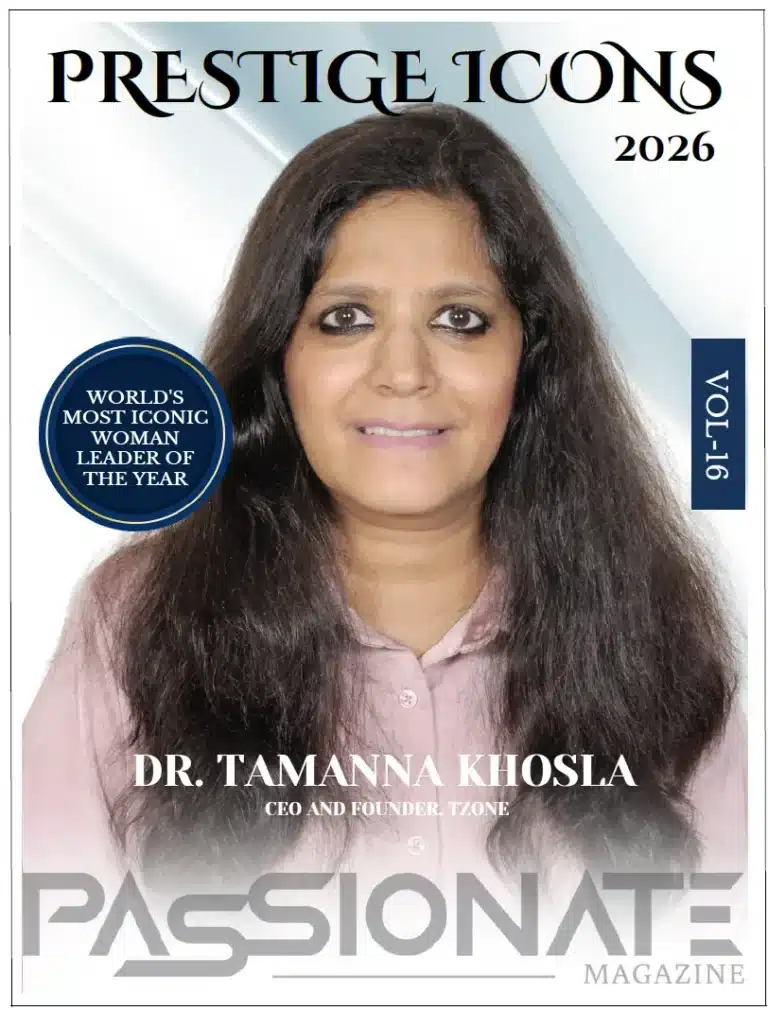
Dr. Tamanna Khosla: Redefining Leadership Through Knowledge, Empathy, and Purpose
Some leadership journeys are built around corporate milestones, while others emerge from a deeper search for knowledge and meaning. Dr. Tamanna Khosla’s journey belongs to the latter. As CEO and Founder of TZONE, she brings together an unusual mix of academic thought, law, philosophy, feminism, research, spirituality, and social responsibility. Her work reflects a belief that meaningful progress cannot be created by looking at a problem from only one angle.
Her curiosity began remarkably early. As a child, she was fascinated by the universe, astronomy, medicine, and the possibility of solving some of the world’s most difficult problems. That curiosity later developed into a serious academic path. She studied political science at Lady Shri Ram College, pursued her master’s at Jawaharlal Nehru University, and continued into M.Phil. and doctoral research, where her interests expanded into law and philosophy.
Her professional journey was not without setbacks. After teaching at Delhi University, she faced an unexpected break from academia and struggled to find a place within the traditional academic system. Rather than allowing that experience to end her intellectual journey, she chose another path. She became an independent scholar, legal thinker, author, philosopher, and feminist intellectual, eventually writing ten books and pursuing legal education.
That experience shaped a leadership philosophy grounded not in titles or institutional power, but in independence, resilience, and purpose.
Leadership Built on Empathy and Integrity
At the centre of Dr. Khosla’s approach is a simple set of values: honesty, sincerity, empathy, and spiritual awareness. These principles influence how she views leadership, relationships, knowledge, and the wider role of an organisation.
For Dr. Khosla, leadership is not about authority alone. It is about understanding people and creating an environment where their abilities can be recognised and used meaningfully. Her earlier experiences with academic structures strengthened her belief that institutions often fail to recognise people whose abilities do not fit conventional models.
Her philosophy therefore places human potential at the heart of leadership. She believes that people should not be judged only by standard measures of success, but by the value they can bring when given the right opportunity.
This people-first approach is also reflected in her belief that empathy should have a central place in professional life. Her leadership perspective sees vulnerability and emotional understanding as strengths rather than weaknesses. She has also expressed a willingness to learn from criticism, viewing it as a way to improve rather than as a threat.
Her message to future professionals is equally direct: “Don’t be corrupt. Don’t run after money. Work for the welfare of the world and its organisms.” The statement captures the ethical foundation behind her wider vision.
Innovation Through Multidisciplinary Thinking
Dr. Khosla’s approach to innovation begins with the belief that complex problems rarely have simple or single-discipline solutions. Her intellectual journey has crossed political science, feminism, philosophy, law, science, spirituality, and social thought. Rather than treating these areas as separate, she sees connections between them.
This multidisciplinary outlook has become an important part of her vision for TZONE. The organisation is envisioned as a platform where scientific thinking can interact with social science and wider questions about humanity.
Her approach also moves innovation beyond the traditional focus on products, markets, and financial returns. She sees research as a tool for addressing human and planetary challenges. Her interests extend to major diseases, global justice, animal welfare, artificial intelligence governance, international law, cosmology, and the future of humanity.
The breadth of these interests reflects a larger belief: innovation should ultimately improve life, expand understanding, and serve a wider purpose.
Turning Setbacks into Intellectual Strength
The challenges in Dr. Khosla’s career have played a major role in shaping her identity. Her departure from academia could have marked the end of a conventional professional path. Instead, it became the beginning of a different chapter.
She chose intellectual independence over allowing external systems to define her future. Writing became one of the most important ways through which she continued to express her ideas. The completion of ten books stands among her proudest achievements and represents years of sustained intellectual effort.
Her journey demonstrates that professional setbacks do not always have to become limitations. They can also create the freedom to explore new directions.
Previous accounts of her work have highlighted this resilience, particularly her ability to continue developing ideas across disciplines despite prolonged professional challenges.
For Dr. Khosla, spirituality has also provided an important source of strength. She describes herself as deeply connected to the universe and believes that a higher power continues to inspire her work. This spiritual perspective sits alongside her academic and intellectual interests, creating a worldview in which knowledge and inner purpose remain closely connected.
Building a Research Vision for the Future
The next chapter of Dr. Khosla’s journey is closely linked to research and collaboration. She is working toward launching her own research business, with the ambition of bringing together talented minds from around the world.
The idea reflects the same multidisciplinary spirit that has defined her career. Instead of building an organisation around one narrow area of expertise, the vision is to create a space where different forms of knowledge can interact and generate new ideas.
Her long-term ambitions are equally broad. She hopes to contribute to the search for solutions to major diseases, explore questions about life beyond Earth, and encourage deeper research into humanity and the universe. Previous profiles have also highlighted her interest in areas such as international justice, global governance, artificial intelligence governance, cosmology, and interdisciplinary systems thinking.
These ambitions may appear far-reaching, but they are consistent with the curiosity that has guided her since childhood. Her career has never followed a narrow line. It has continually expanded toward questions that challenge established boundaries.
A Human-Centred Impact
Beyond academic and professional achievements, Dr. Khosla’s larger contribution lies in her attempt to connect knowledge with social responsibility. She believes systems should make room for people with different abilities, perspectives, and forms of potential.
That belief is especially important in a world where organisations increasingly rely on standard measures of performance and success. Her experience has led her to advocate for systems that recognise difference rather than exclude it.
Her vision also extends beyond human progress. Animal welfare, environmental responsibility, social justice, and the wider future of life are part of the ethical framework surrounding her work. Her view is that progress should not be measured only by wealth or technological advancement, but by how fairly and responsibly that progress is shared.
Her philosophy challenges the idea that financial success should be the central measure of achievement. Instead, she places greater value on purpose, contribution, and lasting impact.
A Different Definition of Success
Dr. Tamanna Khosla’s journey represents a different model of leadership, one built through curiosity, adversity, independent thinking, and a strong sense of responsibility. Her story moves beyond the traditional path from education to position and from position to recognition. It is instead a continuing search for knowledge and a desire to use that knowledge for wider human benefit.
The creation of TZONE represents the next stage of that journey. With a vision centred on research, multidisciplinary collaboration, and human welfare, Dr. Khosla is working toward an organisation that reflects the values that have shaped her life.
Her greatest achievement may therefore not be a single title, degree, or publication. It may be the persistence to keep asking difficult questions when conventional systems provide limited answers.
In a world increasingly shaped by technology, social change, and complex global challenges, such thinking has growing relevance. Dr. Khosla’s leadership offers a clear reminder that innovation needs ethics, knowledge needs empathy, and progress needs purpose.
Her journey continues to evolve, but its central idea remains consistent: knowledge becomes truly valuable when it is used to create a better future for people, society, and the wider world.